Where To Park Your Cash in Jun 2026 in Singapore
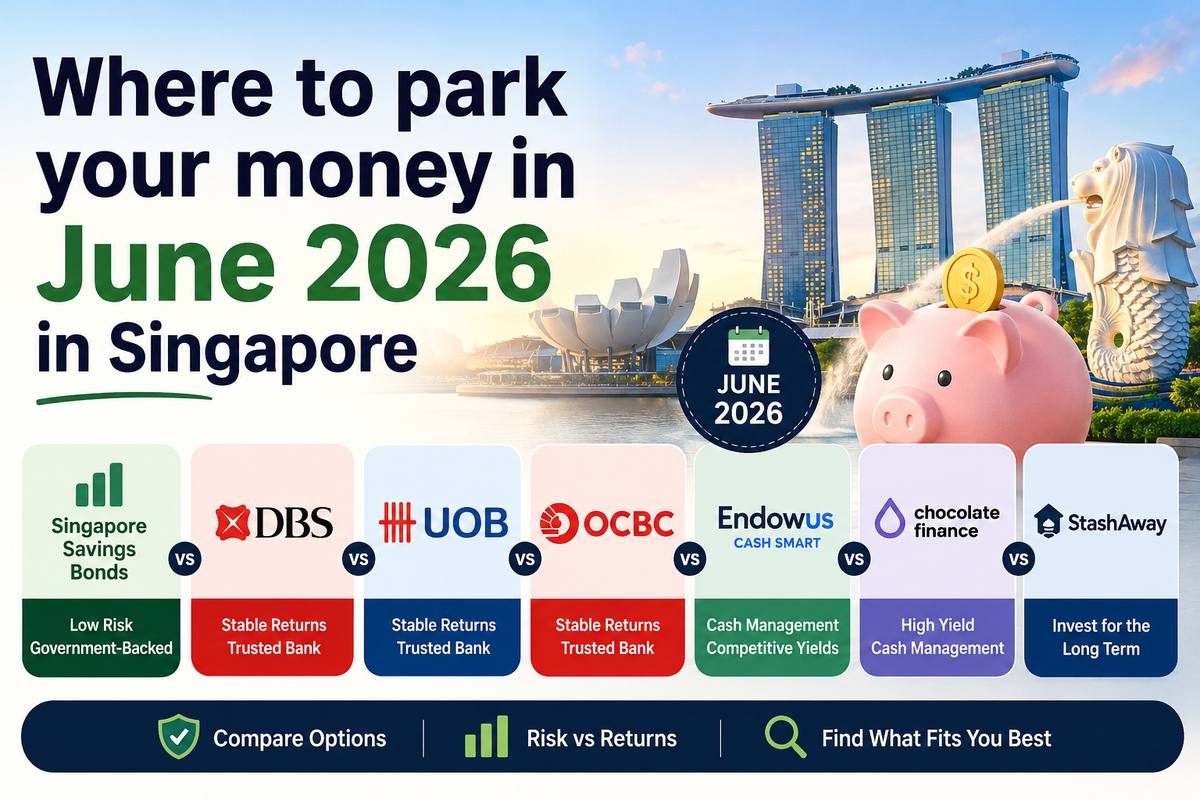
Rates are sourced from official bank websites and financial comparison platforms as of June 2026. Interest rates change frequently — verify current rates before making any decisions. This is not financial advice.
The S&P 500 just hit another all-time high. The Straits Times Index is not far behind. If you are anything like me, you are sitting on a pile of cash that you are not ready to deploy into equities right now — because deploying into an all-time high feels wrong, even when you know, intellectually, that markets make new all-time highs all the time.
So the question is not whether to invest. It is where to park this cash while you wait for the right moment — or for the 10–15% pullback that may or may not come.
I ran through every option available in Singapore this month. Here is what I found.
Three Questions to Ask Before Deciding
Before comparing accounts, get clear on three things:
1. How much are you allocating? The size of your cash pile changes the maths entirely. Some accounts cap bonus interest at SGD 75,000. Others go to SGD 100,000 or SGD 150,000. For amounts above those caps, you need a split strategy. I will run the numbers for SGD 50K, SGD 100K, and SGD 150K below.
2. Can you realistically meet the conditions? High-yield savings accounts in Singapore advertise sky-high rates — but only if you fulfil monthly conditions like salary GIRO, minimum card spend, insurance purchases, and maintaining a growing balance. Missing one condition in a given month can collapse your rate to near-zero. If your cash situation is volatile, or you cannot reliably meet the criteria, the advertised rate is fictional.
3. Are you willing to accept some risk? Bank savings accounts (DBS, UOB, OCBC) are SDIC-insured up to SGD 75,000 per depositor per bank. Singapore Savings Bonds are government-backed. Cash management products like EndowUs, StashAway, and Chocolate Finance invest in money market and bond funds — they are low-risk, but they are not risk-free, and they are not SDIC-insured.
Your answers to these three questions should drive the decision. The comparison below is the toolkit.
The Options at a Glance
| Product | Max Rate | Balance Cap (for max rate) | Conditions Required | SDIC Protected |
|---|---|---|---|---|
| OCBC 360 | 4.45% EIR | SGD 100,000 | 5 conditions (salary, spend, save, insure, invest) | Yes (up to SGD 75K) |
| DBS Multiplier | 4.10% p.a. | SGD 100,000 | Salary + 3 categories + high transaction volume | Yes (up to SGD 75K) |
| UOB One | 1.90% EIR | SGD 150,000 | Salary + SGD 500 card spend | Yes (up to SGD 75K) |
| Singapore Savings Bond | 1.46% (Yr 1) / 2.11% (10Y avg) | SGD 200,000 | None | Government-backed |
| EndowUs Cash Smart Enhanced | ~2.15% (net of fee) | No cap | None | No |
| Chocolate Finance | 3.00% (first SGD 20K) | SGD 20K boosted | None | No |
| StashAway Simple Fixed | 1.05% | No cap | Fixed tenor required | No |
Deep Dive: Each Option
1. DBS Multiplier
DBS Multiplier gives bonus interest when you credit your income (salary, dividends, or rental income) into a DBS/POSB account and transact across one or more eligible categories: credit card/PayLah! retail spend, home loan instalment, insurance, or investments.
The bonus interest applies on the first SGD 100,000 in your account. The rate is determined by two variables: how many categories you transact in, and your total monthly transaction volume.
DBS Multiplier Rate Table (as of 2026)
| Monthly Transaction Volume | Income + 1 Category | Income + 2 Categories | Income + 3+ Categories |
|---|---|---|---|
| SGD 500 – SGD 15,000 | 1.80% | 2.00% | 2.20% |
| SGD 15,000 – SGD 30,000 | 1.90% | 2.40% | 3.00% |
| Above SGD 30,000 | 2.20% | 3.00% | 4.10% |
Source: DBS Bank official website. Rates for first SGD 100,000; base rate of 0.05% applies above.
The 4.10% maximum rate requires both 3+ categories and total monthly transactions exceeding SGD 30,000. For most salaried professionals — who are spending SGD 1,000–5,000 per month on their card and making insurance or investment contributions — landing in the SGD 500–15K tier with 2 categories (salary + card spend) is more realistic: that puts you at 2.00%.
To hit 3.00% or above: you need to either rack up very high monthly transaction volumes (mortgage instalment helps a lot here) or hold multiple DBS products.
Pros:
- Flexible — multiple paths to bonus interest, you don’t need a specific card
- No minimum salary amount (any income credit counts)
- Works well for DBS mortgage holders (home loan counts as a category)
Cons:
- Rate depends on monthly transaction volume, which can vary
- Need income credit — manual transfers don’t count
- Max bonus only on first SGD 100,000
- 4.10% requires unrealistically high monthly transactions for most people
2. UOB One
UOB One used to be Singapore’s most straightforward high-yield account. It was cut three times in 2025, and from 1 December 2025, the maximum effective interest rate dropped to 1.90% p.a. — the lowest it has been in years.
UOB One Rate Table (effective December 2025)
Path A: Salary GIRO (≥ SGD 1,600) + Card Spend (≥ SGD 500/month)
| Balance Tier | Interest Rate p.a. | Monthly Interest |
|---|---|---|
| First SGD 75,000 | 1.00% | ~SGD 62.50 |
| Next SGD 50,000 (SGD 75K–125K) | 2.50% | ~SGD 104.17 |
| Next SGD 25,000 (SGD 125K–150K) | 3.40% | ~SGD 70.83 |
| Max EIR on SGD 150,000 | 1.90% | SGD 237.50 |
Path B: Card Spend (≥ SGD 500) + 3 GIRO debit transactions/month (no salary)
| Balance Tier | Interest Rate p.a. |
|---|---|
| First SGD 125,000 | Up to 1.40% EIR |
Path C: Card Spend only (≥ SGD 500)
| Balance Tier | Interest Rate p.a. |
|---|---|
| First SGD 75,000 | Up to 0.65% EIR |
Source: UOB Bank official website / MileLion, rates effective 1 December 2025.
The standout point about UOB One: it is the only account that applies bonus rates on balances up to SGD 150,000. For very large cash holdings, this structural advantage is meaningful — even if the rate itself is now unexciting.
Pros:
- Simple two-step qualification (salary + card spend)
- Largest balance cap of the three bank accounts (SGD 150,000)
- Rate tiers are very transparent — no guessing
Cons:
- Rate slashed significantly — 1.90% max EIR is no longer competitive
- You are earning 1.00% on your first SGD 75,000, which is barely above inflation
- Requires a UOB card and consistent spending
3. OCBC 360
OCBC 360 is now the most competitive bank savings account in Singapore, with a maximum EIR of 4.45% on the first SGD 100,000 when all five conditions are met. Rates were cut from 5.45% effective 1 May 2026, but they remain the highest of the three major bank accounts.
OCBC 360 Rate Table (effective 1 May 2026)
| Category | Requirement | Bonus Rate | Notes |
|---|---|---|---|
| Salary | Credit ≥ SGD 1,800/month via GIRO | Up to 1.25% p.a. | Rate varies by balance tier (1st SGD 75K vs next SGD 25K) |
| Save | Increase average daily balance by ≥ SGD 500 | Up to 0.40% p.a. | ADB must rise every month — hard to maintain long-term |
| Spend | Spend ≥ SGD 500/month on OCBC credit/debit card | Up to 0.25% p.a. | Must be OCBC-branded card |
| Insure | Hold an eligible OCBC insurance product | Up to 1.25% p.a. | Bonus paid for 12 months from policy purchase |
| Invest | Buy an eligible OCBC investment product | Up to 1.25% p.a. | Bonus paid for 12 months from investment |
| Base | None | 0.05% p.a. | Always earned |
Source: OCBC Bank official website. Rates effective 1 May 2026.
Combined EIR by conditions met (on first SGD 100,000):
| Conditions Met | Effective Interest Rate |
|---|---|
| Salary only | ~1.30% |
| Salary + Save | ~1.70% |
| Salary + Save + Spend | ~1.95% |
| Salary + Save + Spend + Insure or Invest | ~3.20% |
| Salary + Save + Spend + Insure and Invest | 4.45% |
Source: OCBC Bank / Mothership.sg (April 2026 rate revision announcement).
The catch: hitting 4.45% requires purchasing both an OCBC insurance product and an OCBC investment product. These should make sense on their own financial merits — buying insurance just for the 12-month bonus rate bump is a bad trade unless you needed the coverage anyway.
Pros:
- Highest max rate of any bank savings account (4.45%)
- Salary + Spend alone gives 1.95% — decent without extra complexity
- Good if you already use OCBC for insurance or wealth products
Cons:
- Five conditions for max rate is the most complex of the three banks
- Insure/Invest bonuses are only for 12 months; rate drops after
- Save category (increasing ADB monthly) is unsustainable over time
- Balance cap at SGD 100,000
4. Singapore Savings Bond (SSB)
The SSB is the safest option on this list. It is backed by the Singapore government, so there is zero credit risk. Unlike fixed deposits, you can redeem it any month with no penalty — you just apply by the end of the month and receive your principal and accrued interest the following month.
SSB June 2026 (GX26060N) — Year-by-Year Rates
| Year | Interest Rate p.a. | Cumulative Average |
|---|---|---|
| Year 1 | 1.46% | 1.46% |
| Year 2 | ~1.80% | ~1.63% |
| Year 3 | ~2.00% | ~1.75% |
| Year 4 | ~2.15% | ~1.85% |
| Year 5 | ~2.25% | ~1.93% |
| Year 6–10 | Step-up to 2.87% by Year 10 | 2.11% avg over 10 years |
Year 1 rate: 1.46%. 10-year average: 2.11%. Source: MAS / Investment Moats, June 2026.
The Year 1 rate of 1.46% is the honest number for anyone parking cash while waiting for a market opportunity. The 10-year average of 2.11% only applies if you hold it the full decade. As the user scenario here involves waiting for a potential market pullback — likely within 1–2 years — the relevant benchmark is Year 1 at 1.46%.
Pros:
- Zero credit risk — government-backed
- No lock-in: redeem any month
- Applies up to SGD 200,000 per person (by far the highest cap)
- Step-up structure rewards patience
Cons:
- Year 1 rate (1.46%) is the lowest of all options here
- One month delay between redemption request and receiving funds
- Need a CDP account to apply
- Application process (via DBS/OCBC/UOB iBanking) has a monthly cut-off
Bottom line for our use case: SSB is a parking option, not the best one. Use it for the portion of your cash you are genuinely comfortable not touching for 12+ months, where the government backing matters more than the rate.
5. EndowUs Cash Smart
EndowUs Cash Smart invests your money in a portfolio of institutional money market funds and short-duration bond funds. It is not a savings account — it is a cash management product — but the returns are competitive and there are zero conditions to meet.
EndowUs Cash Smart Portfolios (yield as of April 2026)
| Portfolio | Projected Yield p.a. | Net of Endowus Fee (0.15%) | Risk Level |
|---|---|---|---|
| Secure | ~1.80% | ~1.65% | Lowest (pure money market) |
| Enhanced | ~2.30% | ~2.15% | Low-medium (money market + short bond funds) |
| Ultra | ~2.00% | ~1.85% | Low-medium (more volatile) |
Source: Endowus platform / Singsaver, as of April 30, 2026. Yields are not guaranteed.
EndowUs Cash Smart Enhanced is the most popular option and the most relevant for our comparison. At 2.15% net, it is better than SSB Year 1 (1.46%), roughly on par with OCBC 360 without conditions, and outperforms UOB One (1.9% max EIR) on balances above SGD 75,000.
Pros:
- Zero conditions — no salary credit, no card spend, nothing
- No balance cap (scales to any amount efficiently)
- App is clean and withdrawals process quickly
- Good for parking large amounts where bank bonus caps create inefficiency
Cons:
- Not SDIC-insured
- Yield is not guaranteed — it reflects underlying fund performance
- 0.15% annual fee slightly reduces returns
- Enhanced/Ultra portfolios have some short-term NAV volatility
6. Chocolate Finance
Chocolate Finance is Singapore’s most interesting cash management product right now — mainly because of its Top-Up Programme, which guarantees a 3% p.a. return on your first SGD 20,000 (SGD) regardless of underlying fund performance, by topping up the difference out of their own pocket.
Important caveat: this programme expires 30 June 2026 — which is 16 days away at time of writing. After that, returns revert to pure fund performance.
Chocolate Finance SGD Rates (as of June 2026, with Top-Up Programme)
| Balance Tier | Projected Rate p.a. |
|---|---|
| First SGD 20,000 | 3.00% (programme guaranteed until 30 June 2026) |
| Above SGD 20,000 | ~2.00% (fund performance, not guaranteed) |
Source: Chocolate Finance official website / YouTrip blog, June 2026.
After 30 June 2026, Chocolate Finance’s SGD returns will depend entirely on the underlying portfolio. Their own blog suggests rates may settle in the 2.0–2.5% range, but this is not guaranteed.
Pros:
- Best no-conditions rate for small amounts (3% on first SGD 20K — right now)
- Simple app, no frills
- Miles earning option available for frequent flyers
Cons:
- Top-Up Programme expires 30 June 2026 — that is two weeks away
- Not SDIC-insured
- Rate after programme expiry is unknown and fund-dependent
- Effective rate drops significantly on balances above SGD 20K
- Not suitable for large cash parking due to low rate on amounts above SGD 20K
My honest take: Chocolate Finance is worth a look today — but only if you understand the 30 June cliff. If you deposit money now and withdraw before the end of June, you’ll have earned 3% for a few weeks on the first SGD 20K. Beyond June, treat it like any other cash management fund and compare yields at that point.
7. StashAway Simple Fixed
StashAway’s Simple product line now has three variants. The one the user is asking about — Simple Fixed — offers a guaranteed, locked-in rate for a fixed tenor. As of 8 June 2026, the rate is 1.05% p.a.
StashAway Product Comparison
| Product | Rate | Lock-in | Risk |
|---|---|---|---|
| Simple Fixed | 1.05% (as of 8 Jun 2026) | Fixed tenor (specific end date) | None — rate guaranteed |
| Simple | ~2.5% projected | None | Very low (money market) |
| Simple Plus | ~4.1% yield to maturity | Suggested 12+ months | Low-medium (bond funds) |
Source: StashAway website, June 2026. Simple Plus YTM is not the same as projected annual cash yield.
At 1.05%, Simple Fixed is the least competitive option in this comparison for pure yield. It makes sense only if you need absolute certainty on your return for a specific time horizon — such as locking in a rate for a known future expense.
If you are already using StashAway and want a better return with minimal conditions, Simple (2.5%) or Simple Plus (~4.1% yield to maturity, but with some NAV fluctuation) are more relevant options.
Pros:
- Guaranteed rate locked upfront — no surprises
- No minimum or maximum balance
- Zero conditions required
Cons:
- 1.05% is the lowest rate of all options compared here
- Locked for a fixed tenor — reduces flexibility
- Not SDIC-insured
- Simple (non-fixed) and Simple Plus both offer better returns for most use cases
Scenario Analysis: How Much Will You Actually Earn?
Now the part that matters. I am running three scenarios — SGD 50K, SGD 100K, and SGD 150K — to show you the real dollar impact.
Assumptions:
- Salary credit condition is met for all bank accounts requiring it
- Card spend condition (SGD 500/month) is met
- For OCBC 360, I model three sub-scenarios: basic (salary + save + spend), with one wealth product (+ insure), and all five conditions
- SSB uses Year 1 rate (1.46%) — the only relevant rate if you may redeem within 12 months
- Chocolate Finance uses 3% on first SGD 20K, 2% on balance above that (within June programme)
- EndowUs Cash Smart Enhanced uses 2.15% net of fees
- All figures are annual
Scenario 1: SGD 50,000
| Product | Conditions | Annual Interest | Effective Rate |
|---|---|---|---|
| OCBC 360 | Salary + Save + Spend + Insure + Invest | SGD 2,225 | 4.45% |
| DBS Multiplier | Salary + 3 categories (high txn vol) | SGD 2,050 | 4.10% |
| DBS Multiplier | Salary + 2 categories | SGD 1,500 | 3.00% |
| Chocolate Finance | None (programme, till 30 Jun) | SGD 1,200 | 2.40% |
| EndowUs Cash Smart Enhanced | None | SGD 1,075 | 2.15% |
| DBS Multiplier | Salary + 1 category | SGD 1,100 | 2.20% |
| OCBC 360 | Salary + Save + Spend only | SGD 975 | 1.95% |
| SSB | None | SGD 730 | 1.46% |
| StashAway Simple Fixed | Fixed tenor | SGD 525 | 1.05% |
| UOB One | Salary + SGD 500 card spend | SGD 500 | 1.00% |
🏆 Winner — SGD 50K: OCBC 360 (all 5 conditions) at 4.45% = SGD 2,225/year.
Runner-up: DBS Multiplier with 3 categories and high transaction volume at 4.10% = SGD 2,050/year.
No-conditions winner: Chocolate Finance at 2.40% = SGD 1,200/year — but only until 30 June 2026. After that, switch to EndowUs Cash Smart Enhanced.
Scenario 2: SGD 100,000
| Product | Conditions | Annual Interest | Effective Rate |
|---|---|---|---|
| OCBC 360 | All 5 conditions | SGD 4,450 | 4.45% |
| DBS Multiplier | Salary + 3 categories | SGD 4,100 | 4.10% |
| DBS Multiplier | Salary + 2 categories | SGD 3,000 | 3.00% |
| EndowUs Cash Smart Enhanced | None | SGD 2,150 | 2.15% |
| DBS Multiplier | Salary + 1 category | SGD 2,200 | 2.20% |
| OCBC 360 | Salary + Save + Spend | SGD 1,950 | 1.95% |
| SSB | None | SGD 1,460 | 1.46% |
| UOB One | Salary + card spend | SGD 1,375 | 1.375% |
| StashAway Simple Fixed | Fixed tenor | SGD 1,050 | 1.05% |
| Chocolate Finance | ~SGD 50K effective cap | ~SGD 1,200 | ~1.20% |
⚠️ SDIC Note: SDIC insurance covers only SGD 75,000 per depositor per bank. For SGD 100,000 in a single bank account, SGD 25,000 is uninsured. This is extremely low risk given Singapore’s banking stability — but if you want full coverage, split between two banks.
🏆 Winner — SGD 100K: OCBC 360 (all 5 conditions) at 4.45% = SGD 4,450/year.
Runner-up: DBS Multiplier (3 categories) at SGD 4,100/year.
No-conditions winner: EndowUs Cash Smart Enhanced at SGD 2,150/year — clearly ahead of SSB, UOB One, and Chocolate Finance for this balance.
Scenario 3: SGD 150,000
The math gets interesting here. All three bank accounts cap their bonus rates at SDG 100,000 or below. Amounts above the cap earn only the base rate (0.05%). This means for SGD 150,000, you need to think in terms of a split strategy.
Single-account approach:
| Product | Annual Interest | Effective Rate | Notes |
|---|---|---|---|
| OCBC 360 (all 5) | SGD 4,475 | 2.98% | Bonus on first SGD 100K only; extra SGD 50K earns 0.05% |
| DBS Multiplier (3 cat) | SGD 4,125 | 2.75% | Same cap issue |
| EndowUs Cash Smart Enhanced | SGD 3,225 | 2.15% | Full SGD 150K earns, no cap |
| UOB One | SGD 2,850 | 1.90% | Only account that applies tiered rates to full SGD 150K |
| SSB | SGD 2,190 | 1.46% | Full SGD 150K at Year 1 rate |
| StashAway Simple Fixed | SGD 1,575 | 1.05% | Full amount |
Split strategy (recommended):
| Split | Product A | Product B | Combined Annual Interest | Blended EIR |
|---|---|---|---|---|
| SGD 100K + SGD 50K | OCBC 360 (all 5, 4.45%) | EndowUs Enhanced (2.15%) | SGD 4,450 + SGD 1,075 = SGD 5,525 | 3.68% |
| SGD 100K + SGD 50K | DBS Multiplier (4.10%) | EndowUs Enhanced (2.15%) | SGD 4,100 + SGD 1,075 = SGD 5,175 | 3.45% |
| SGD 100K + SGD 50K | OCBC 360 (all 5) | SSB (1.46%) | SGD 4,450 + SGD 730 = SGD 5,180 | 3.45% |
| SGD 75K + SGD 75K | OCBC 360 (all 5) | UOB One | SGD 3,338 + SGD 1,425 = SGD 4,763 | 3.18% |
Calculation: OCBC 360 on SGD 75K at ~4.45% EIR ≈ SGD 3,338; UOB One on SGD 75K at 1.0% = SGD 750 + up to SGD 75K applies at 1.0% = SGD 750 actually.
🏆 Winner — SGD 150K: Split strategy — SGD 100K in OCBC 360 (all 5 conditions) + SGD 50K in EndowUs Cash Smart Enhanced = SGD 5,525/year → 3.68% blended EIR.
This decisively beats leaving SGD 150,000 in any single account.
Pro tip: You could also spread the SGD 50K remainder between SSB (for government-backed safety) and EndowUs Cash Smart Enhanced — e.g., SGD 25K in each — for a better risk-adjusted outcome on the uncapped portion.
Pros & Cons Summary
| Product | Best For | Watch Out For |
|---|---|---|
| OCBC 360 | Maximising rate if you can meet all 5 conditions | Insurance/invest bonus is temporary (12 months); save condition is hard to maintain indefinitely |
| DBS Multiplier | DBS mortgage holders; those with high monthly transaction volumes | Rate depends heavily on transaction volume; 4.10% requires spending patterns most people cannot sustain |
| UOB One | Large balances above SGD 100K (applies to SGD 150K) | Max 1.9% EIR is no longer competitive; far outclassed by OCBC 360 for first SGD 100K |
| SSB | Safety-first; money you won’t need for 1+ year; amounts over SGD 100K | Year 1 rate of 1.46% is lowest here; one month delay to redeem; not suitable for short-term waiting |
| EndowUs Cash Smart Enhanced | Large cash amounts with no conditions; splitting strategy for excess above bank caps | Not SDIC; yields can fluctuate |
| Chocolate Finance | Small amounts (under SGD 20K) right now — best no-conditions rate | Programme expires 30 June 2026; post-programme returns uncertain; not SDIC |
| StashAway Simple Fixed | Guaranteed return for a known time horizon | 1.05% rate is uncompetitive; locked tenor reduces flexibility |
My Recommended Approach
If you can meet conditions (salary GIRO + card spend): Start with OCBC 360. Salary + Spend + Save gets you 1.95%, which is solidly above UOB One’s maximum of 1.90%. If you already have an OCBC insurance or investment product, your rate jumps to 3.20%+. For the cash above SGD 100,000, park it in EndowUs Cash Smart Enhanced.
If you want zero conditions: Chocolate Finance for the first SGD 20,000 right now (3% until June 30). Move to EndowUs Cash Smart Enhanced after that. For the rest, SSB if safety is your priority, EndowUs if efficiency matters more.
If you are parking SGD 100K+ while waiting for a market pullback: Split. SGD 100,000 in OCBC 360 with all conditions maxed, the remainder in EndowUs Cash Smart Enhanced. This gives you 3.68% blended on SGD 150,000 — roughly SGD 5,525 per year while you wait — which is not nothing.
A Word on Timing
Every account on this list has seen rate cuts in the past 12 months. UOB One was cut three times in 2025 alone. OCBC 360 just cut from 5.45% to 4.45% in May 2026. If global interest rates continue falling, Singapore savings rates will follow.
The best approach is not to chase the perfect account forever. Pick the option that fits your conditions and amount, set it up, and revisit it quarterly. The difference between the top two options at any point in time is usually measured in tens or hundreds of dollars a month — meaningful, but not worth agonising over daily.
Your cash is working harder than it was a few years ago. Make sure it keeps doing that while you wait for your next opportunity.
Rates verified from official bank websites and MAS data as of June 2026. Always confirm current rates directly with the provider before making financial decisions. This post is for informational purposes only and is not financial advice.
Sources consulted:
- DBS Multiplier Account — Official DBS website
- OCBC 360 Account — Official OCBC website
- UOB One Account — Official UOB website
- MAS Singapore Savings Bonds — MAS official
- OCBC 360 May 2026 Rate Cut — Mothership.sg
- UOB One December 2025 Rate Cut — MileLion
- EndowUs Cash Smart — Official Endowus website
- Chocolate Finance — Official website
- StashAway Simple Fixed — Official StashAway website
- SSB June 2026 Yield — Investment Moats